
How AI search visibility differs from SEO
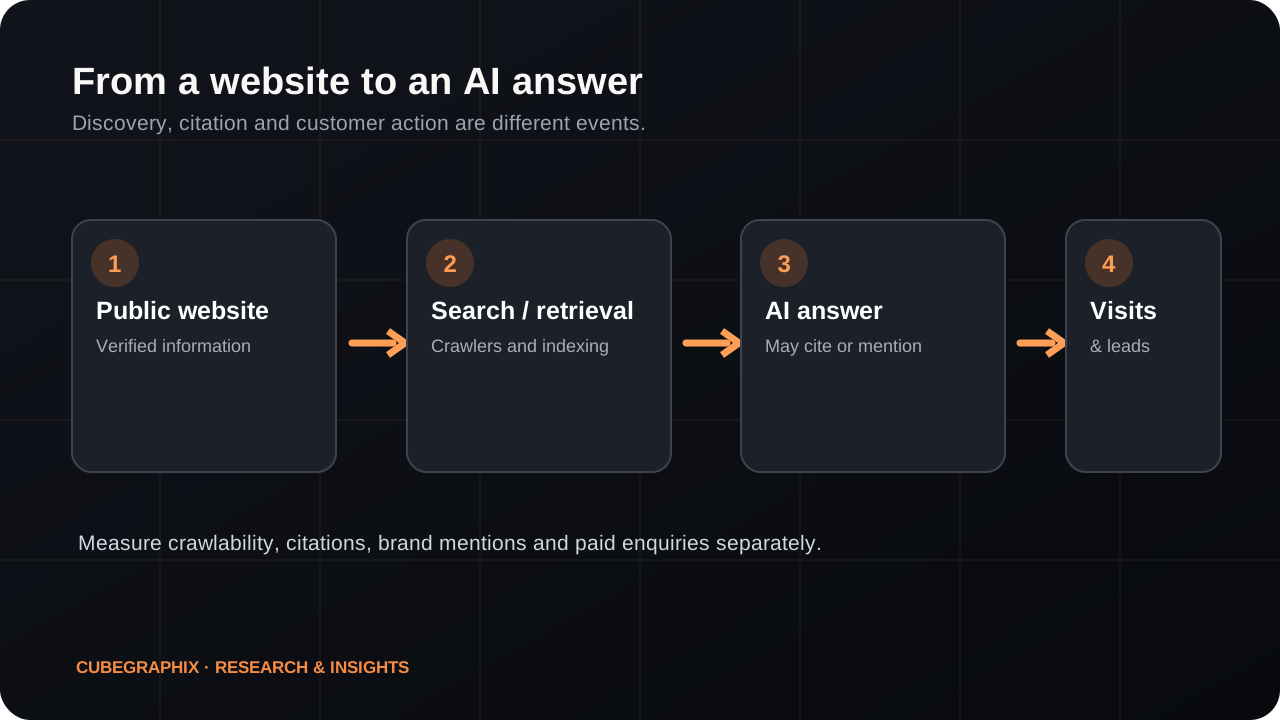
Traditional search optimization aims to make pages discoverable and useful in search results. AI-powered search experiences can retrieve web sources, summarize them, and sometimes cite or recommend businesses. Those are separate outcomes. A company may have an indexed page yet receive no citations; another may be mentioned in a response without generating a website visit.
For planning, distinguish five states: crawlable, indexed or discoverable, cited, named, and recommended. Then track enquiries and paid work separately. None of these stages guarantees the next.
Start with the website people can read
Google's AI features guidance points to normal search eligibility and high-quality, accessible content. A practical starting point is a page that actually explains what the business does, who it serves, and what evidence supports those claims. Make services, geography, relevant credentials, contact methods, and any meaningful limitations available in ordinary HTML.
- Check that important public pages return the intended HTTP status and are not accidentally blocked by robots or a firewall.
- Use meaningful titles, headings, internal links and a current sitemap.
- Keep organization names, service descriptions and contact details consistent across pages.
- Link to genuine case studies, product information or original research when it directly helps the reader.
Schema and llms.txt: useful checks, not shortcuts
Relevant Schema.org structured data can make page facts machine-readable. Implement Organization, Article or other appropriate types only when they match visible, verified page information. More schema does not inherently improve the quality of the underlying content.
An optional llms.txt can provide a concise public site guide for compatible tools. Keep it accurate, limited to approved public URLs and derived from the same facts as the site. It is not a special requirement for appearing in Google's AI search features; avoid creating parallel copies of facts that will become outdated.
Make content worth referring to
Instead of repeating keywords, provide useful explanations that someone could independently check. Specific examples, transparent comparisons, original screenshots, dated research and attributed quotations make an article more helpful. The foundational GEO research explored how changes to source documents affected visibility in a controlled synthesis environment, but it did not prove that a fixed percentage of extra citations will occur for live commercial websites.
Measure what is observable
Use Search Console, Bing Webmaster Tools and analytics for first-party search and referral evidence where accessible. For AI answer sampling, choose a stable set of buyer questions, markets, languages and engines. Repeat the same prompts on a defined schedule; save the dates, source URLs and whether the business was named, cited or recommended.
AI answers may vary between tests. A “share of AI voice” computed from 30 sampled prompts is a sampling metric, not a census of every user's conversations. Report the denominator and limitations. When paid enquiries arrive, attribute them to the actual marketing journey rather than assuming the last citation caused a sale.
A practical 30-day starting sequence
- Week 1: verify public URLs, crawl access, indexing, critical services and contact paths.
- Week 2: clarify business identity, service pages, relevant schema and existing content gaps.
- Week 3: build a 20–40 question monitoring baseline for the actual target market.
- Week 4: improve the highest-value pages and compare observations without claiming early causation.
This work can be part of a bounded website audit before buying a monthly AI visibility platform.
An AI-search visibility audit starts with five separate questions
An effective audit begins by defining what “visibility” means. A business may ask whether an AI system knows its name, whether it can retrieve the latest service page, whether it cites that page, whether it includes the company among options for a buyer, or whether the interaction produces a genuine enquiry. Those are different questions, with different data requirements. Treating them as a single score usually hides more than it explains.
Discovery asks whether search infrastructure can reach relevant pages. For a public service page, check the response status, robots rules, canonical declaration, actual rendered text and whether the page is discoverable through internal links. Source inclusion asks whether a particular answer cites a URL; a citation is observable when that answer actually shows a link, but a missing citation does not prove the page was never crawled. Brand inclusion asks whether the business is named. The model may name a company from an external directory rather than its site. Recommendation asks whether the model actively suggests the business for a relevant task. Commercial contribution asks whether a traceable visitor, enquiry and payment occurred.
For each question, identify a practical evidence source. A URL Inspection result supports some indexing questions, a real browser/HTTP check supports accessibility, a recorded answer supports a sampled mention, and a signed contract or actual payment supports business conversion. No one analytics dashboard measures all five. An agency report should use a small observation table with columns for outcome, measurement method, evidence date and confidence rather than a visually impressive unsupported “AI visibility score”.
| Question | Evidence | What it does not prove |
|---|---|---|
| Can the URL be reached? | Live HTTP and crawl test | That an AI answer will cite it |
| Was the URL cited? | Recorded source link or supported provider citation report | That users clicked it |
| Was the company recommended? | Saved question and answer with date/market | That all users see the same response |
| Did the activity generate business? | Qualified lead and payment history | That one citation caused the sale |
This separation also prevents a common reporting error: using the number of generated answers mentioning a brand as a substitute for lead quality. A niche service provider may need only a few high-intent enquiries, whereas a large publisher may care more about broad source citations. The audit must follow the business model, not the tool’s easiest available chart.
Crawlability, rendering and indexing: inspect the real delivery path
Before changing content for generative search, confirm the ordinary website can be served reliably. Request several representative public URLs from outside the site’s authenticated environment. Look for HTTP 200 where appropriate, the intended canonical URL, no accidental noindex directive, and no CDN challenge that blocks a legitimate visitor or relevant crawler. A JavaScript-heavy page can look complete in a browser but expose too little useful information in its initial document. Rendering support differs by system; the practical safeguard is to ensure the essential business facts appear as accessible text in delivered HTML whenever feasible.
Inspect robots.txt and the CDN or WAF independently. A permissive robots file cannot override a 403 or a bot challenge at the network edge. Likewise, allowing one user-agent does not establish that every search or AI surface will crawl, index or cite the page. Separate normal Googlebot and Bingbot access from optional AI-related crawler policies. The operator must decide which use of content to permit, considering legal, privacy and security requirements rather than blanket-enabling every bot.
OpenAI documents distinct crawler/user-agent purposes, including OAI-SearchBot for search-related discovery and GPTBot for model-training-related crawling. The site owner should review those distinctions before adopting a rule from a generic “AI bot list”. See the official OpenAI crawler overview. Search engines can change bot behavior; policy needs periodic review, not a permanent one-time exemption.
For each essential URL, record an observation bundle: public path, requested URL, response status and redirect chain, canonical URL, indexability directive, last sitemap inclusion, mobile accessibility and evidence timestamp. Test pages that represent different structures: home, about, major service, an article, a location page when legitimate and contact. If a site has language variants, ensure each canonical and language alternative resolves to a real public page rather than a nonexistent translated placeholder.
The actual business consequence of a technical failure is straightforward. A clinic may have a strong services page, but if its CDN presents a challenge to relevant crawlers, those systems may not reliably obtain the information. Fix the access issue first. Rewriting the service page to sound more “AI-friendly” does not solve the distribution failure. Conversely, when crawling is healthy and a provider is absent from sampled recommendations, avoid declaring crawling the cause without evidence of the next stages.
Business identity and entity consistency: make the facts unambiguous
AI discovery is especially fragile when the same company is represented by conflicting names, phone numbers, domains and service descriptions. A small business should maintain one verified identity record in its real website data authority, then render that information consistently into the home, About, Contact and relevant service pages. This need not become a new knowledge graph database. For a lean static site, a canonical JSON file or existing CMS data can supply the mutable facts and prevent one page from saying London while another says Manchester.
Describe what the organization actually does. “Digital solutions for tomorrow” is not a useful substitute for “responsive websites, online stores and managed website care for small businesses”. Where the business has a legitimate service area, clarify it. Where the company has qualifications, named professionals, regulated services or physical locations, show only approved evidence. For healthcare, legal or financial services, inaccurate credentials are both a trust and compliance problem, not an SEO tactic.
Profiles and directories can reinforce identity when they are genuine and maintained: a business profile, sector association, LinkedIn Company Page, relevant regional directory or platform listing. They should not be created as hundreds of thin citations solely to influence AI outputs. Link to owned profiles that truly belong to the same business. For example, the sameAs property in applicable structured data can reference verified official accounts; it must not be used to connect the company to unrelated high-authority profiles.
Build a small factual checklist: official registered/trading name, canonical website, approved brand spelling, primary contact, countries served, principal services, company description, verified social identity URLs and evidence of claims. The final list is not an editorial invention: it should come from the client’s approved site information. For a website redesign, reconcile old URLs and outdated third-party profile data instead of simply copying old schema into the new build.
One useful test is to ask a colleague unfamiliar with the company to answer five questions using the published site alone: What do they sell? To whom? Where? What is their distinguishing approach? How does a buyer contact them? If the answers are unclear to a person, the business should prioritize clear pages and evidence rather than elaborate semantic markup. AI optimization should improve understanding, not create a parallel reality available only to crawlers.
Structured data: implement truthful schema without speculative promises
Structured data encodes information about a page or organization in a machine-readable vocabulary. It does not replace the readable page. Google’s structured-data guidance explains how supported markup can help search features interpret content. Google also states that no special AI-specific schema is required for its AI search features. Both points can be true: appropriate schema is a sensible implementation detail, but adding it alone does not establish higher AI citation probability.
Start from the page’s role. A real organization can use relevant Organization properties; a verified business location may use a suitable LocalBusiness subtype. A genuinely authored article can use Article or BlogPosting with actual title, author and publication information. A breadcrumb trail can use BreadcrumbList. Product, event or review markup belongs only where the page genuinely presents that information and meets the applicable provider conditions. Do not add fabricated ratings, synthetic reviews or fake dates.
For example, a service provider might expose an Organization node with the canonical name and website URL, and an Article node for a research guide with a valid mainEntityOfPage URL. The article date must reflect a real publication event; an internal draft created on Tuesday should not be dated as published on Tuesday if it remains a private preview until Friday. Author identity should be useful and traceable rather than a keyword-filled pseudonym.
Implementation should read values from the existing approved source of truth where possible. A hard-coded footer contact and separate schema contact array are two future sources of inconsistency. On a small static site the simplest approach may be a build-time template that consumes the canonical site facts, or carefully maintained page-specific data where no build system exists. Avoid adding a framework merely to output JSON-LD.
Validate with parser and provider-specific testing, compare markup to visible text, and revisit it after substantive page changes. Record the URLs tested, warning/error types and date. Be wary of tools that declare every missing optional property a “critical GEO failure”; the required properties depend on actual schema type and desired feature. Include schema in client SEO/GEO checklists because it is cheap and verifiable when implemented correctly, while explicitly separating implementation completion from unproven performance outcomes.
The llms.txt option: a public guide, not a second website
The proposed llms.txt convention provides a compact, Markdown-like entry point listing important public resources for compatible AI-oriented tools. Some site owners find this useful as a lightweight way to describe their documentation or services. It is reasonable to include a small, accurate file where the ongoing maintenance burden is negligible. What is not reasonable is to describe it as a mandatory Google AI Overview inclusion requirement: Google explicitly says no special AI text files are required.
A cautious implementation contains a short organization description and links to canonical public home, Services, About, Contact and selected resource pages. It should not reveal private preview URLs, unpublished client reports, internal deployment routes, secret admin panels or staging assets. Publishing a path does not make that path accessible if it is secured correctly, but publicly advertising sensitive paths creates avoidable discovery and maintenance risks.
Do not maintain a second editable list of all site services inside the file. When the website already has a canonical route and content inventory, derive links from it or update the compact guide during the same release. If the site has only six useful public pages, a 20-line guide is more robust than a second full website content export. Separate Markdown mirror pages or llms-full.txt files introduce additional version synchronization and duplicate-publication concerns; implement them only when there is a documented consumer need.
Test the file as a public text resource: request it directly, inspect the content type if relevant, follow every link, verify each linked page is intended for public access and confirm that changing a service URL cannot leave the guide stale. Document the file’s purpose honestly as an optional compatibility aid. If future evidence shows a specific retrieval engine relies on the format, that can inform a targeted improvement—but claiming general citation improvement today would overstate the evidence.
A useful client report can state “public llms.txt present, valid and linked to the approved service pages” as an observed configuration fact. The report should not assign an unsupported “20% GEO lift” to the change. Clear language makes this both an implementable standard and an accurate public recommendation: inexpensive experiments can be worthwhile even when their search-ranking impact is not proven.
Content design: organize around buyer questions, not arbitrary keyword lists
Relevant content is more useful when it follows a customer’s actual decisions. A contractor evaluating software might ask which integrations are essential, what implementation costs, how handover works and who will maintain it. A patient evaluating a specialist clinic might want clear treatment information, genuine credentials, location and how to request an appointment. Writing fifty nearly identical articles containing the phrase “best [service] near me” does not solve either journey.
Begin with service pages that answer commercial questions. Explain the offer, audience, included deliverables, meaningful exclusions and next action. Then build a pillar page that provides a navigable overview of one broader field. Supporting articles should each answer a narrower topic with a concrete checklist, worked example or comparison that does not duplicate the pillar. Internal links should help the visitor move between these levels naturally rather than force every paragraph back to the same sales CTA.
Google’s people-first content documentation asks whether material adds original value, draws on firsthand experience and satisfies a real information need. This is a stronger editorial test than hitting a word count. A 4,000-word pillar can be justified by meaningful breadth; if a narrow issue has only a 700-word useful answer, combine it with another page rather than expand it with broad, repetitive prose.
For an AI-search article, useful original assets might include a diagram separating crawling from citation, an annotated service-page example showing where the company’s real facts live, or a reporting table comparing Search Console evidence with prompt-based sampling. Real source screenshots should show genuine platform data and dates; a fictional visual explanation should be explicitly illustrative. A graphic should make a difficult idea easier to understand, not merely decorate a keyword page.
Plan updates when official platform rules change, client facts change or new observations meaningfully improve the advice. Avoid automatic date changes solely to appear fresh. In practice, one maintained cornerstone guide and a handful of strong supporting studies will often create a more coherent knowledge resource than a large collection of thin articles. The commercial benefit is also clearer: a reader can learn, compare options and ask for a specific assessment without navigating a manufactured SEO maze.
A repeatable AI-answer baseline: design the sampling protocol
When a business asks whether ChatGPT or another answer engine recommends it, a single prompt run is an anecdote. A more useful baseline uses a defined set of questions that represent buying decisions. Separate generic discovery questions (“which kinds of providers offer this service?”) from branded validation questions (“what does [company] offer?”). The latter can confirm factual accessibility but is a poor proxy for unbiased recommendation visibility. Include commercial-intent, comparison and information-seeking prompts, noting how they differ.
Document the parameters before running the study: engine and interface, whether a search or browsing mode is enabled, location or locale, language, the exact prompt, date/time, whether personalized conversation history was present, and whether the test used a clean session. Never suggest a result is identical for all users; engines may personalize, refresh sources, experiment with response formats or choose different citations. If a platform does not expose location controls, describe the test context as known rather than inventing a geographic setting.
For a lean monitoring pilot, select perhaps 20–40 buyer-relevant prompts and repeat them consistently. This range is an operational starting point, not a statistical standard. More prompts may produce a smoother descriptive series, but they also increase cost and reviewer work. Deduplicate substantially identical questions. Record the full answer, visible citations, relevant named brands, top-line recommendation and whether the answer addresses the intended service. For a binary mention rate, show numerator and denominator. If 6 of 30 sampled answers named the business, report 6/30 sampled responses—not “20% of all AI search traffic”.
Establish an internal annotation rule. Count a mention only if the correct brand or recognized trading name appears. Count a citation only when a source link to an approved URL is actually shown. Count a recommendation only when the response clearly suggests the business for the use case, not merely lists a directory that contains it. When two reviewers disagree about a classification, resolve and record the example rather than silently changing the denominator.
Then compare periods cautiously. If the sampled citation rate moves from 6/30 to 9/30, the change may reflect content improvements, engine behavior, source index updates or random variation. It is a reason to investigate, not proof that a particular schema edit caused the outcome. Keep controlled release dates for page changes and supplement sampling with first-party visits and lead data when available. This is how a monitoring retainer becomes an honest information service rather than a guarantee about a black-box system.
Use free first-party tools before buying a visibility platform
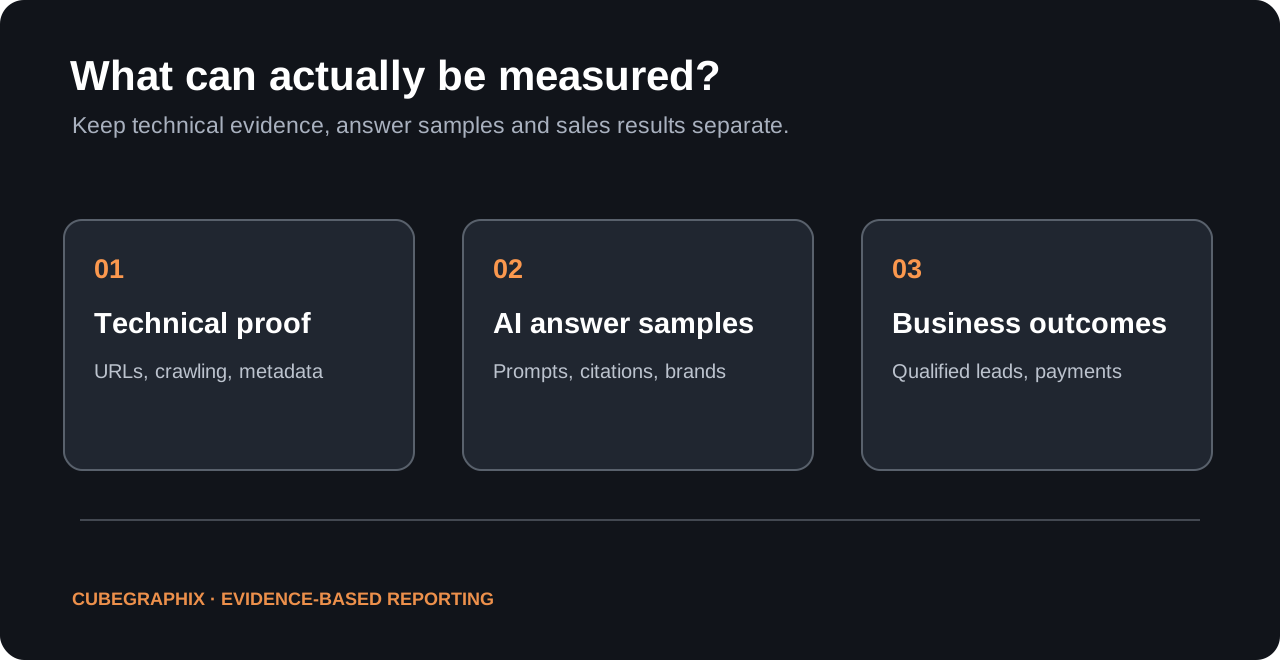
A small agency does not need a large AI-search software subscription to begin. Start with tools that already expose direct operational evidence. Google Search Console provides search impressions, clicks, queries and indexing diagnostics for eligible verified properties. It does not provide a comprehensive feed of every ChatGPT recommendation. Bing Webmaster Tools offers crawl and search diagnostics; its AI Performance preview reports aggregated citations and referenced pages across supported Microsoft experiences. The documentation explicitly says cited-page counts are not rankings or page importance.
For website health, use direct browser and HTTP checks, a small internal-link crawl, the appropriate structured-data validators and real Core Web Vitals data when there is enough traffic. Use Google Analytics or equivalent first-party analytics to study actual referral sessions and meaningful conversion events. Set up event definitions that distinguish a clicked contact link from an enquiry successfully received by the business. A mailto link that merely opens the visitor’s email application does not confirm a sent or delivered message.
Paid APIs such as DataForSEO AI Optimization may reduce manual sampling work, but the business case depends on what their endpoints actually return, their pricing per request, supported engines/markets, freshness and data-processing limitations. Treat any provider-computed “AI visibility score” as that provider’s metric with a defined collection method, not an objective market census. Compare a small benchmark dataset with manually observed answers before relying on a new API. Avoid collecting every possible metric merely because it is available.
A lean dashboard can contain three separate groups: verified technical state (crawl/index/schema), observed search/referral performance (Search Console/Bing/analytics) and sampled AI-answer observations. In the commercial section, include qualified enquiries, proposed work, signed clients and collected payments only when the existing sales ledger supports them. If the company is paying for outreach, an API subscription and social ads, count those costs along with relevant sales labor in channel economics; a low API price is not useful if no additional paying customer results.
Upgrade the stack when the manual workflow is demonstrably too expensive or inconsistent. For example, recurring work across 15 client sites with approved standardized sampling and reliable report exports might justify a modest API cost. One or two pilot clients generally justify a compact spreadsheet or existing report engine instead. This keeps software subscriptions from becoming the product’s primary operating cost before the service itself has proven demand.
Worked example: from an unclear clinic page to a measurable improvement
Consider a fictional physiotherapy practice with a technically reachable website. Its home page contains a large image and the slogan “Movement for Life”, but the page does not clearly identify offered treatments, practitioners, opening hours or the appointment path. The business sees little AI-answer visibility and asks for a new llms.txt file. Adding that file before fixing the content would address a speculative compatibility feature while leaving obvious buyer questions unanswered.
A sensible audit starts with evidence. First, inspect the public home, treatments, team and contact pages from a mobile browser and a crawler-oriented HTTP client. Check canonical URLs, robots directives and whether the treatment pages are linked from the navigation. Next, interview the client to validate actual services, practitioner credentials, service area and booking policies. This content cannot be invented from competitor pages. The client’s official evidence is the authority for what the website may say.
Then restructure the treatment pages so a visitor can understand the problem addressed, what the service involves, appropriate limitations, who provides it and how to enquire. Add relevant structured data where it accurately matches the visible pages. A compact public llms.txt may point to these canonical pages, but it remains a supplemental guide. Use genuine practitioner images and appropriate clinic photography with permission; an AI-generated clinician portrait would create an unnecessary trust problem.
After publication, establish a small pre-defined question set such as “physiotherapy for sports injury in [actual service area]” and “how to book a physiotherapist at [practice]”. Record whether the practice is named or cited and whether the website now produces more real appointment enquiries. Treat results at the appropriate confidence level. If the clinic later receives three additional verified bookings, the team should determine whether they came through the updated page, a referral, social advertising or another source rather than claiming the AI-search file generated them.
The example illustrates what a credible agency delivers: accurate pages, functional access, evidence of implementation and a bounded method to assess progress. It also explains why conversion work matters. An AI citation that leads to an unclear booking form can still waste demand; an excellent booking experience on a site that nobody can find has a different distribution problem. Search readiness and commercial usability need to be reviewed together.
GEO experiments and evidence: separate research from commercial results
Researchers have studied how content changes influence appearance in responses from generative systems. The often-cited Generative Engine Optimization (GEO) research evaluates transformations such as adding citations, quotations, statistics or clearer presentation in a defined experimental setting. Its findings are worth understanding because they suggest ways to make information more useful as source material. However, the experimental visibility metric, the tested systems and the corpus are not interchangeable with a live local business’s ChatGPT recommendations or paying customers.
Before using any percentage from a study in a client report, ask five questions: What exactly was measured? Was it a source-word visibility score, a clicked citation, a mention or a sale? Which engines and conditions were tested? Were the interventions applied to a controlled set of passages or to continuously indexed real sites? How reproducible were the effects across topics and query types? Does the study provide enough information to justify the causal claim we intend to make?
Likewise, vendor analyses of Google AI Overviews, click-through rates and search behavior may be informative without being universally transferable. A measured change for informational queries in one period does not mean the same shift will apply to a dentist’s branded appointment search or an industrial manufacturer’s quote requests. Check sampling frame, time range, country, query mix and whether the figures reflect paid or organic results. Do not mix numerator/denominator definitions across different reports to create a persuasive-looking chart.
At CubeGraphiX, a practical experimental log can use one intervention per meaningful change window. Record the baseline page, its content and technical condition, the approved modification, date, relevant queries, observed search/citation data and alternative explanations. A test of business-info clarity may overlap with a redesign, a new sitemap and a marketing campaign; acknowledge those concurrent changes rather than claim that a single JSON-LD property caused the measured improvement.
Research should guide hypotheses, not manufacture guaranteed results. If a carefully designed answer-first section improves comprehension for human visitors and becomes easier for source-retrieval systems to quote, that is a plausible dual benefit. Publish such an improvement because it is accurate and useful, monitor its performance and stay prepared to revise the hypothesis. This protects both the client and the credibility of the agency’s authority articles.
Common failure modes and a responsible client service model
Several recurring mistakes make AI-search work unnecessarily expensive or misleading. The first is attempting an AI-only layer before repairing broken basic SEO. If important content is hidden behind a login, script failure, incorrect canonical or edge challenge, the starting task is availability and source integrity. The second is generating many thin articles around every prompt variant. This creates duplication, review effort and stale facts while offering little reason for people or other sites to refer to the business.
A third mistake is replacing authentic business evidence with synthetic credibility: fabricated testimonials, invented professional biographies, fake office photography or claims that a company is “recommended by ChatGPT”. These assertions can mislead potential buyers. Use actual project examples, consented client materials, original technical diagrams and accurate excerpts from approved studies instead. A fourth mistake is measuring success only by a proprietary share-of-voice percentage without preserving the exact question set and sampling method. Without a reproducible denominator, the percentage may not be comparable month to month.
A fifth mistake is introducing a new API platform, database and continuous bot operation before defining the client deliverables. A lean first engagement is usually a bounded Website Growth Audit that inspects crawlability, identity, useful content, conversion path and a small AI-answer baseline. Its output is an evidence-based prioritized report with affected URLs, scope, cost/effort estimate and verification method. The implementation phase then fixes confirmed problems. Recurring monitoring comes after the client sees the value of the baseline and understands the limits of observing black-box answer engines.
A practical monthly service might review Search Console/Bing and first-party conversion trends, retest the same prompt set, refresh a limited number of high-value pages, resolve indexing or content inaccuracies and produce one concise actionable report. Specify what is included, which assets require approval and what is out of scope. A monthly deliverable should not promise an arbitrary number of AI citations, rankings or articles. The content schedule must follow actual search demand and client evidence, not a quota.
Finally, protect recoverability. Keep editable business identities in their established source, client-specific website changes in the owning repository, and reports as derived deliverables. Record acceptance, deployment and rollback for material changes. If a proposed optimization conflicts with the site contract or privacy obligations, update the contract or reject the change. A successful GEO service is not measured by how many new files and tools it installs; it is measured by trustworthy improvements and a better-informed customer decision.
A 90-day roadmap and questions for the business owner
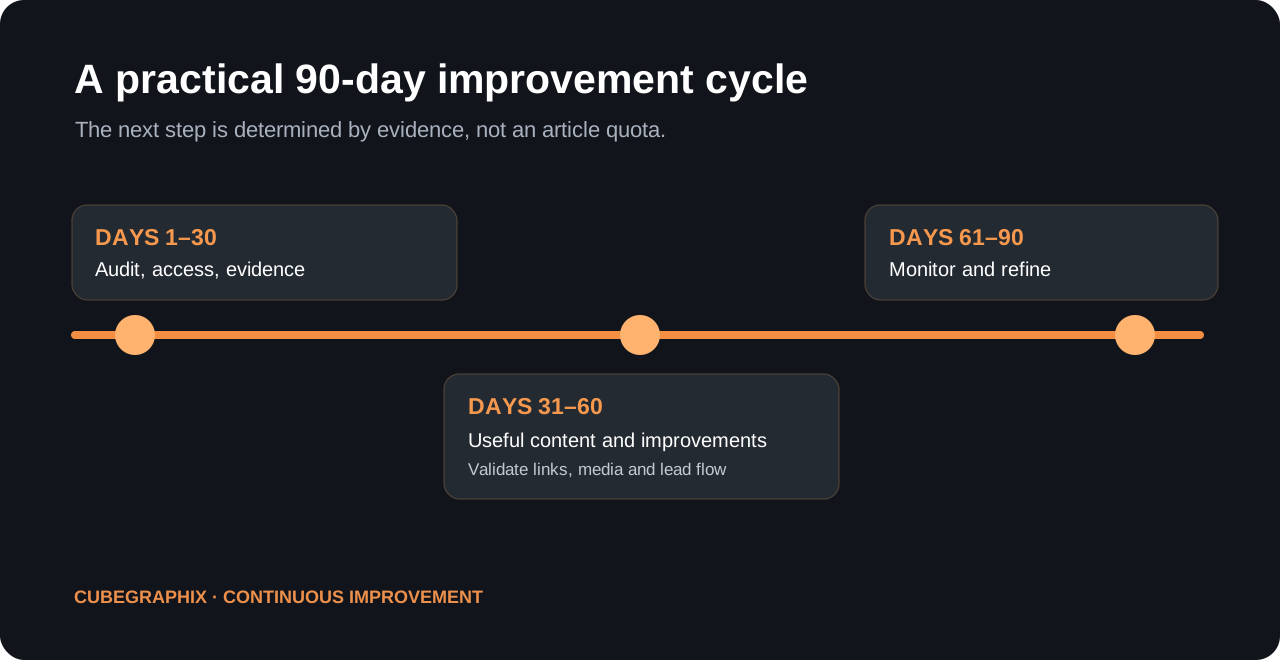
Days 1–15: establish truth and access. Collect official company information and actual service details. Verify public landing pages, robots/canonical/sitemap behavior, edge access, mobile usability and contact action. Fix incorrect statements and obvious dead ends before producing additional content. Export or document the starting Search Console/Bing/analytics view where the client has given access. Build the first buyer-question inventory, selecting a manageable number of prompts and clearly specifying the markets and engines under review.
Days 16–30: make the site useful and measurable. Rewrite one or two priority service pages with the client’s approved facts, evidence and clear next action. Add relevant structured data and, where appropriate, a compact public llms.txt linked to canonical resources. Validate rendered HTML and source metadata. Run the first consistent AI-answer sampling cycle. Correct analytics so a successful enquiry is not confused with a button click. Prepare the client-facing audit that distinguishes confirmed findings from optional experiments.
Days 31–60: publish a small connected knowledge base. Develop one genuinely substantive pillar article and supporting pages answering distinct customer questions. Use diagrams, first-party examples and accurate citations rather than generic AI illustrations alone. Improve internal links from services to useful guides and back, without creating circular keyword-heavy menus. Compare impressions, citations and qualified enquiries to the recorded baseline; do not interpret short-term fluctuations as causal proof. If the business lacks authority off-site, prioritize legitimate professional associations and verified business profiles over mass citation campaigns.
Days 61–90: learn which changes matter. Review real query demand, content usefulness, conversion records and the repeatability of prompt-sampling metrics. Retire weak reports, improve pages that attract qualified enquiries and preserve a log of meaningful revisions. Only consider a paid AI monitoring API if the retained clients and staff time justify it. Expand from one pilot to more businesses using the same evidence rules, not a bespoke dashboard or separate source-of-truth database for every client.
Before commissioning work, a business owner should ask the provider: Which results can we verify independently? Which changes are established SEO essentials and which are experiments? Who owns the content and source files? Can we see the exact sampled questions and answers? What is the monthly delivery limit? Who approves public claims and client photographs? How do you attribute actual enquiries and collected payments? What happens if a tool is discontinued? These questions are more useful than asking for a guaranteed number of AI mentions.
Further reading and source material
These references support the technical guidance and provide context for further verification.
- Google Search Central — AI features
- OpenAI crawler documentation
- GEO research (Aggarwal et al.)
- Bing Webmaster Tools — AI Performance
Improve the website, not just the metrics.
CubeGraphiX helps businesses identify and address practical website, search and conversion problems. Start with a short description of your business and goals.
Request a website growth audit ↗